

Bajra (Pearl Millet) – Winter Grain, Benefits & Nutrition
Bajra (pearl millet), the heating winter grain of Rajasthan and Haryana: its taseer, dosha effect, nutrition, and how to eat bajre ki roti with ghee and gur.
Mon, Sep 28, 2026 · 6 min read🌾 Bajra at a Glance
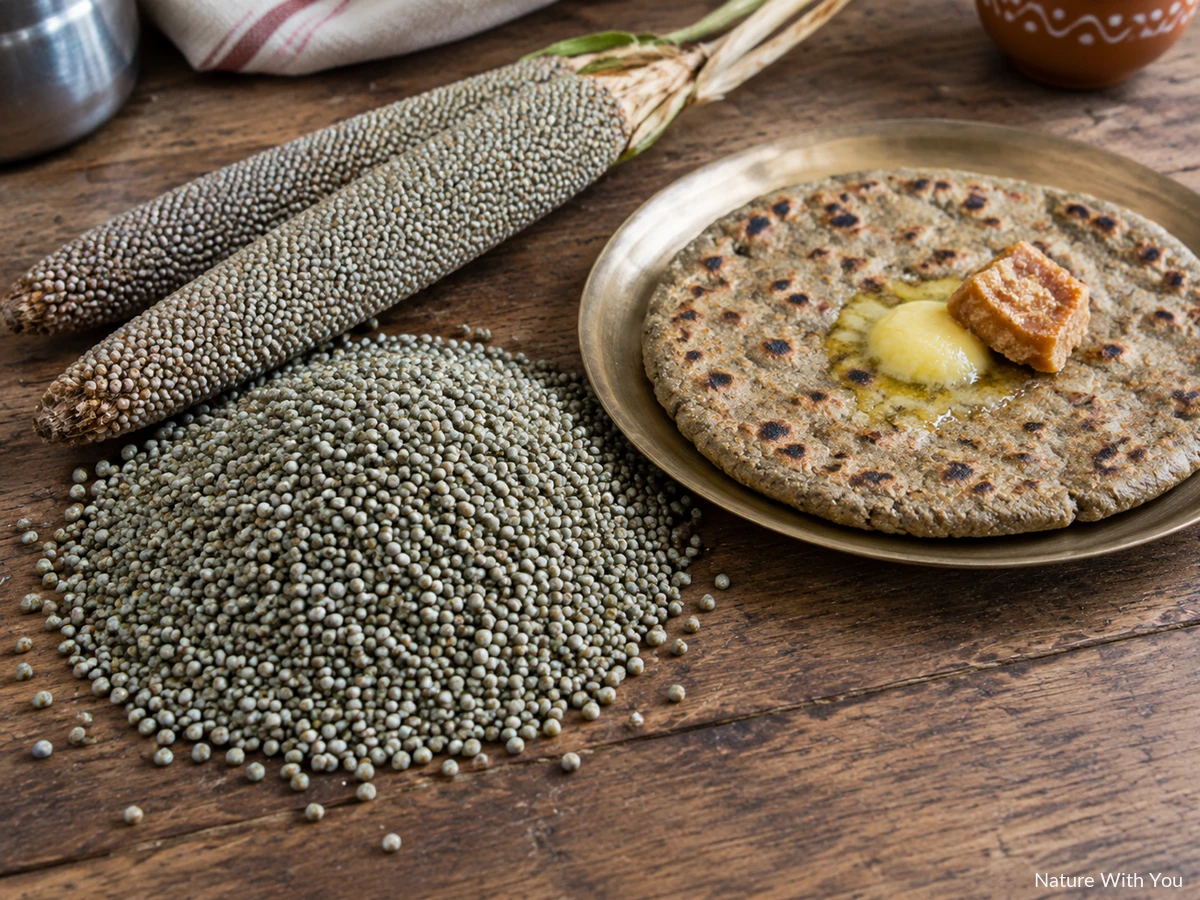
Bajra — pearl millet — is the grain of India’s dry north-west. It grows on sandy soil with little rain, ripens in the monsoon, and comes into its own when the cold arrives. From Jodhpur to Rohtak, the winter kitchen means bajre ki roti, thick and hand-patted, eaten hot with a generous spoon of ghee, a lump of gur, and perhaps sarson ka saag or a bowl of buttermilk. It is gluten-free, notably rich in iron among cereals, and filling in a way wheat is not.
✨ Why It’s Special / Importance
- 🔥 A heating grain in the traditional reckoning — the winter staple of Rajasthan, Haryana and Gujarat
- 🩸 One of the better cereal sources of iron
- 🌾 Naturally gluten-free
- 🏜️ Thrives on poor, dry land where wheat and rice struggle
- 🥣 Dense and satisfying; a little goes a long way
🏺 Traditional / Ayurvedic Uses
Bajra is not described in Charaka Samhita or Sushruta Samhita. What follows is the position of later regional practice in north-west India, where bajra has been eaten for centuries.
Rasa (Taste): Madhura (Sweet), with a faint astringent note Virya (Potency): Ushna (Hot) Vipaka (Post-digestive): Not fixed with confidence in the sources; we leave it unstated Guna (Qualities): Ruksha (dry), relatively Guru (heavy) Dosha Effect: Its heat and dryness counter Kapha; its heat helps against the cold of Vata, provided its dryness is offset with ghee; excess can aggravate Pitta
Traditional Applications:
- A cold-season grain, eaten from roughly Kartik to Phalgun and set aside in summer
- Always paired with ghee — to counter its dryness — and often with gur, a warming partner
- Cooked with moong dal into a soft khichdi for those who find the roti too heavy
- Made into raab, a thin porridge with buttermilk, in Rajasthan and Gujarat
💪 Benefits / Health Effects
- ✅ Warmth in Winter: Its ushna nature is why north-west India leans on it in the cold months
- ✅ Iron: Contributes more iron than most cereals, which may support everyday energy
- ✅ Satiety: Fiber and fat make a bajra meal filling and slow to digest
- ✅ Gluten-Free Variety: A traditional grain for those avoiding gluten
- ✅ Steady Energy: Its fiber may support even energy release through the day
- ✅ Seasonal Eating: Fits the ritucharya logic of heavier, warmer food in winter
🥗 Nutritional Information (Per 100g, Whole Grain, Raw)
USDA FoodData Central’s “millet, raw” entry does not specify pearl millet, so these figures are from the Indian Food Composition Tables 2017 (National Institute of Nutrition) for bajra.
| Nutrient | Amount |
|---|---|
| Calories | 348 kcal |
| Carbohydrates | 61.8 g |
| Fiber | 11.5 g |
| Protein | 11 g |
| Fat | 5.4 g |
| Iron | 6.4 mg |
| Calcium | 27 mg |
Note: Bajra’s fat content is higher than most cereals, so its flour turns rancid quickly. Buy or grind in small batches and use within a couple of weeks.
🔄 Quick Comparison: Bajra vs Ragi – Two Millets
| Feature | Bajra (Pearl Millet) | Ragi (Finger Millet) |
|---|---|---|
| Home Region | Rajasthan, Haryana, Gujarat | Karnataka, Tamil Nadu, the hills |
| Stands Out For | Iron, warmth | Calcium |
| Season | Winter | Year-round; ragi malt and ambli in summer |
| Typical Use | Roti with ghee and gur, khichdi, raab | Mudde, dosa, porridge, malt |
Both are gluten-free. Bajra is the one to reach for when the weather turns cold.
🥄 How to Use / Prepare
Culinary Tips:
- 🫓 Bajre ki Roti: Knead the flour with warm water just before cooking — it cracks if left to sit — pat by hand and cook on a tawa; serve with desi ghee and gur
- 🍲 Bajra Khichdi: Soak pounded bajra, then cook with moong dal, ghee and cumin until soft
- 🥣 Raab: Cook bajra flour thin with water and buttermilk, with a pinch of ajwain
- 🍪 Bajre ki Tikki: Flour kneaded with gur and sesame, then fried — a Rajasthani winter sweet
- 🌾 Mixed Flour: Blend a little bajra into wheat atta if a full bajra roti feels too heavy
Traditional Home Practice:
- 🧈 For Dryness: Never eat bajra dry; ghee on the roti is part of the recipe, not an extra
- 🌡️ For the Season: Keep it to winter, and switch to lighter grains as the weather warms
⚠️ Precautions / Warnings
- ❗ Bajra is heating — people with a Pitta constitution, or anyone in the hot months, should eat it sparingly
- ❗ Its dryness can cause constipation if eaten without ghee and enough water
- ❗ It is heavy; start with small portions if your digestion is delicate
- ⚠️ Pearl millet contains flavonoids that have been studied for their effect on iodine uptake where bajra is eaten as the only staple and iodine intake is low. In a varied diet with iodised salt, this is not a practical concern
- ⚠️ Stale flour tastes bitter — a sign it has gone rancid
🎉 Fun Facts / Trivia
- 🌍 Pearl millet was first domesticated in West Africa and reached India thousands of years ago
- 🇮🇳 India is the world’s largest producer of pearl millet, and Rajasthan grows the most of any state
- 🏅 The United Nations declared 2023 the International Year of Millets, at India’s proposal
- 🌾 Millets are now promoted in India under the name Shree Anna
Frequently Asked Questions (FAQs)
Q: Is bajra hot or cold? A: Traditional north-west Indian practice treats bajra as ushna, or heating. That is why it is a winter grain there and largely set aside in summer.
Q: Why is bajra roti eaten with ghee and gur? A: Bajra is dry and heating. Ghee offsets the dryness; gur adds warmth and makes the roti easier to enjoy. Together they are the classic winter plate.
Q: Is bajra gluten-free? A: Yes. Pearl millet contains no gluten, which is also why its dough cracks and has to be patted by hand rather than rolled.
Q: Can bajra be eaten in summer? A: Occasionally and in small amounts. Raab made with buttermilk is the traditional lighter form; the thick roti is best kept for the cold months.
Related Items
- Ragi (Finger Millet) — the calcium-rich millet of the south
- Chana (Chickpea) — the pulse of the same dry-land fields
- Wheat — the cooling grain bajra is often blended with
- Jowar (Sorghum) — the cooling millet that takes over in summer
- Winter Fruits and Vegetables
- Hot and Cold Foods in Ayurveda
- Desi Cow Ghee
Explore More: Fruits • Vegetables • Herbs • Natural Remedies • Seasonal Picks • Wellness Tips
📚 Sources
- Longvah, T., Ananthan, R., Bhaskarachary, K., Venkaiah, K. (2017). Indian Food Composition Tables. National Institute of Nutrition, Hyderabad — Bajra
- Gaitan, E., Lindsay, R. H., Reichert, R. D., et al. (1989). Antithyroid and goitrogenic effects of millet: role of C-glycosylflavones. Journal of Clinical Endocrinology & Metabolism, 68(4), 707–714
- Food and Agriculture Organization of the United Nations — International Year of Millets 2023