

Khoa (Mawa) – Ayurvedic Nature, Nutrition & Adulteration Test
Khoa (mawa) in Ayurveda: milk cooked down to a heavy, sweet, building food that raises Kapha. Types of khoa, nutrition per 100g, khoa vs paneer, and a simple home test for starch adulteration.
Wed, Sep 30, 2026 · 6 min read🍮 Khoa at a Glance
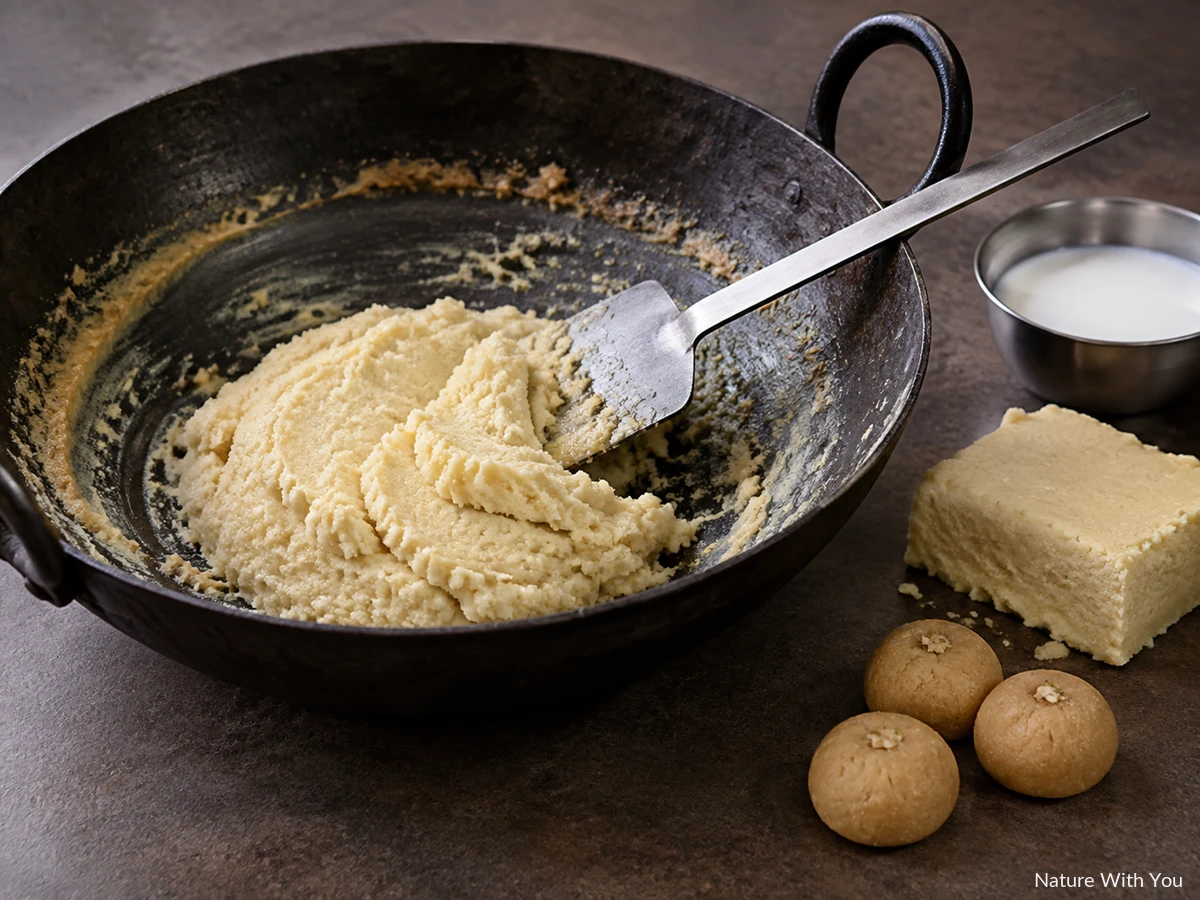
Put a litre of full-cream milk in a heavy kadhai, keep the flame steady, and stir — for forty minutes or more, scraping the sides so nothing catches. The milk thickens, turns to a paste, and finally gathers into a soft, pale mass that leaves the pan clean. That is khoa, or mawa: about a fifth of the milk you started with, and nearly all of its solids. Halwais across North India start their festive season with it. Ayurveda would recognise it simply as milk with the water taken out — and would note that everything that makes milk heavy is now concentrated five times over.
✨ Why It’s Special / Importance
- 🍬 The base of peda, barfi, gulab jamun, kalakand and gajar ka halwa
- 🥛 Keeps milk’s protein, calcium and fat in a dense, portable form
- 🪔 Inseparable from Diwali, Holi and Raksha Bandhan — and from the sweet shop
- 🔥 Made with only milk and patience; no souring agent, no additive
- 🏺 Mathura’s peda and Dharwad’s peda are both khoa, cooked until caramel-brown
🏺 Traditional / Ayurvedic Uses
Rasa (Taste): Madhura (Sweet) Virya (Potency): Usually given as Sheeta (Cool) Vipaka (Post-digestive): Madhura (Sweet) Guna (Qualities): Guru (very heavy), Snigdha (unctuous), Sthira (dense) Dosha Effect: Calms Vata and Pitta; strongly increases Kapha
Classical Applications:
- Khoa has no entry of its own in the classical texts; its properties are commonly given by extension from milk, whose sweet, cooling, heavy and building nature it keeps
- Charaka describes milk as jivaniya and brimhana — life-sustaining and building. Khoa carries these qualities in concentrated form, and with them milk’s heaviness
- The texts' warnings about heavy milk products — slow to digest, Kapha-increasing, unsuited to weak agni — apply to khoa more than to anything else in the dairy family
- Khoa sweets are traditionally eaten in small pieces, after a meal or as prasad, never as a meal in themselves
💪 Benefits / Health Effects
- ✅ Protein and Calcium: About 15 g protein and 650 mg calcium per 100 g of whole-milk khoa
- ✅ Energy-Dense: A little goes a long way — useful where appetite is small and needs are high
- ✅ Building Food: Traditionally given, in small amounts, to the thin and the convalescent
- ✅ No Additives When Homemade: Only milk and heat
- ✅ Keeps Milk’s Sugar: Unlike paneer, the lactose stays in, giving khoa its natural sweetness
🥗 Nutritional Information (Per 100g, Khoa)
| Nutrient | Amount |
|---|---|
| Calories | 421 kcal |
| Carbohydrates | 20.5 g |
| Protein | 14.6 g |
| Fat | 31.2 g |
| Calcium | 650 mg |
| Phosphorus | 420 mg |
Note: Values are for khoa made from whole buffalo milk, from the National Institute of Nutrition’s Nutritive Value of Indian Foods. Khoa from skimmed milk has far less fat and more protein per 100 g. Sugar added in sweets comes on top of these figures.
🔄 Quick Comparison: Khoa vs Paneer
| Feature | Khoa (Mawa) | Paneer |
|---|---|---|
| How it’s made | Milk boiled down in an open pan | Hot milk split with lemon or whey |
| What’s kept | All milk solids, including sugar | Protein and fat; whey drained away |
| Taste | Sweet, cooked-milk flavour | Mild, slightly tangy |
| Guna | Very heavy, unctuous | Very heavy, unctuous |
| Calories (100g) | About 421 | About 265 |
| Used in | Sweets | Savoury dishes |
Both are heavy, Kapha-building milk concentrates. Paneer loses its lactose to the whey; khoa keeps it, which makes it sweeter and more energy-dense.
🥄 How to Use / Prepare
Culinary Tips:
- 🔥 Homemade khoa: Use full-cream milk in a heavy, wide kadhai on a medium flame; stir and scrape constantly until it gathers into a soft ball — about 200 g from a litre
- 🟫 Three kinds: Firm pindi or batti khoa for barfi and peda, grainy danedar for kalakand, soft dhap or chikna for gulab jamun
- 🥕 Gajar ka halwa: Grated khoa stirred in at the end gives the halwa its richness
- 🧊 Storage: Refrigerate and use within a few days; khoa spoils fast at room temperature
Traditional Home Practices:
- 🌿 Cardamom and saffron: Classical partners in khoa sweets, both lightening and aromatic — see saffron
- 🍽️ Sweet after the meal, small portion: The traditional place for a khoa sweet is a single piece after food, not between meals
⚠️ Precautions / Warnings
- ❗ Khoa is dense in fat and calories, and khoa sweets add sugar on top — portions matter
- ❗ Very heavy and Kapha-increasing: go lightly with slow digestion, congestion, or in the damp months
- ❗ Adulteration peaks before festivals. A simple check from FSSAI: boil a little khoa in water, cool it, and add a few drops of iodine tincture — a blue colour indicates added starch
- ❗ Buy from a trusted shop, and avoid khoa that smells sour or feels unusually rubbery
- ⚠️ People with a milk allergy should avoid it
🎉 Fun Facts / Trivia
- 🏺 Mawa and khoa are the same food; khoya is simply a regional spelling
- 🍬 Mathura’s peda is cooked until the khoa browns — the caramel taste comes from the milk itself
- 🥛 Five litres of milk for one kilo of khoa is the halwai’s rule of thumb
- 🪔 In the weeks before Diwali, khoa demand rises so steeply that food-safety teams run special drives on it
Frequently Asked Questions (FAQs)
Q: What is the difference between khoa and mawa? A: None — they are two names for the same milk solids. Khoya is another spelling.
Q: Is khoa heavy to digest? A: Very. It is milk’s heaviness concentrated several times, so it suits small portions, after a meal, with a good appetite.
Q: Is khoa the same as ricotta or milk powder? A: No. Ricotta is made by curdling whey; milk powder is spray-dried. Khoa is slow-cooked in an open pan, which gives it its texture and cooked-milk flavour.
Q: How can I tell if khoa is adulterated? A: Boil a small piece in water, cool it and add iodine; a blue colour means starch has been added. Buying from a known source, or making it at home, is the surest way.
Related Items
Explore More: Grains, Pulses & Dairy • Hidden Treasures • Herbs • Seasonal Picks
📚 Sources
- National Institute of Nutrition (ICMR) – Nutritive Value of Indian Foods, milk and milk products (khoa)
- Charaka Samhita, Sutrasthana 27 (Annapanavidhi Adhyaya) – Gorasa varga
- Sushruta Samhita, Sutrasthana 45 (Dravadravya Vidhi) – milk products
- FSSAI – DART: Detect Adulteration with Rapid Test, milk products