

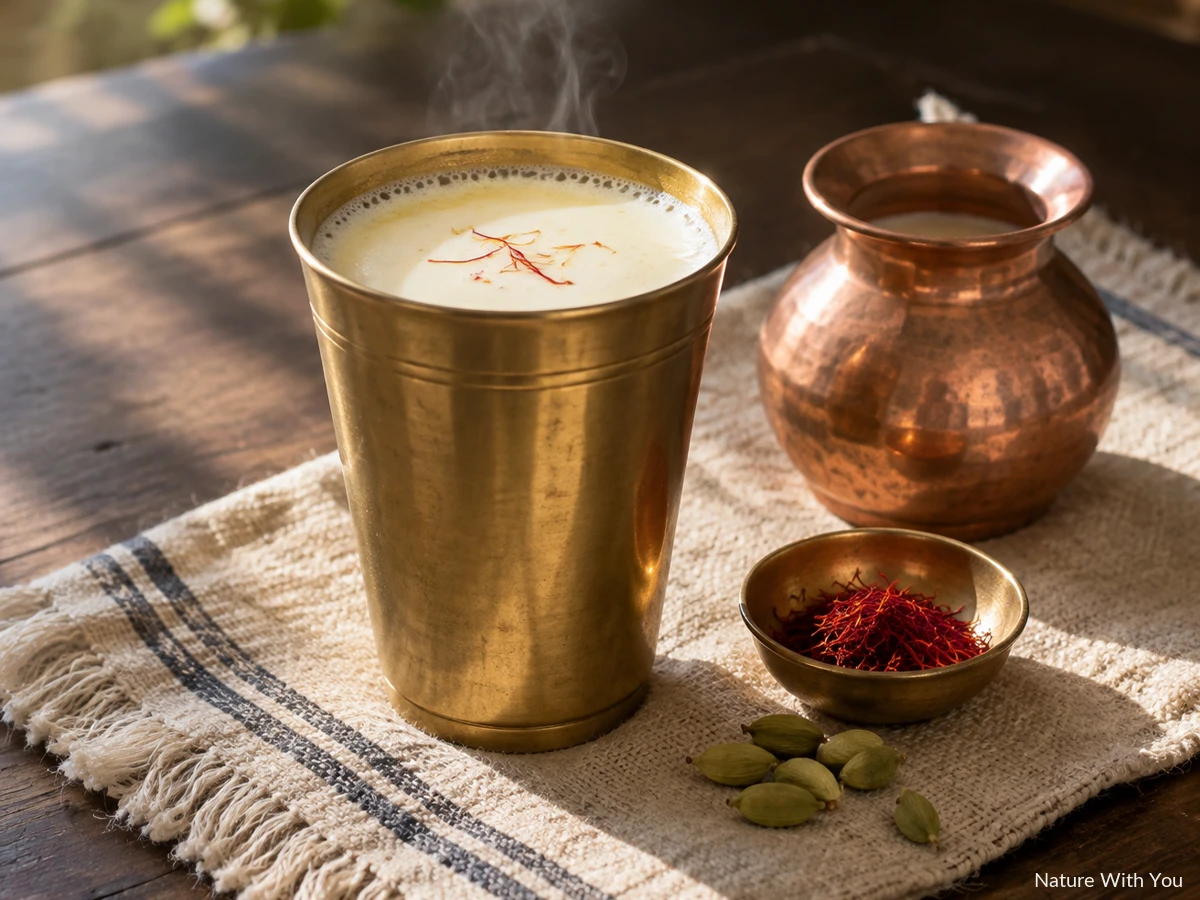
Milk (Doodh) – Ayurvedic Nature, Nutrition & How to Drink It
Milk (Doodh) in Ayurveda: sweet, cooling, heavy Ksheera, praised as the most life-sustaining food. Cow vs buffalo milk, how to boil and spice it, and what not to mix it with.
Tue, Sep 29, 2026 · 6 min read🥛 Milk at a Glance
Milk, or Doodh, is the one food almost every Indian household buys fresh each morning. Ayurveda calls it Ksheera and gives it an unusually high rank: Charaka names milk the foremost of all life-sustaining (jivaniya) foods. Cow’s milk is sweet, cooling, heavy and unctuous — nourishing to every tissue, calming to Vata and Pitta. What sets the Ayurvedic view apart is its attention to how milk is taken: boiled, warm, often spiced, and kept apart from foods it clashes with.
✨ Why It’s Special / Importance
- 🏆 Charaka’s list of foremost substances places milk at the top of the jivaniya (life-sustaining) group
- 🌿 Classed as a daily rasayana — a food for rejuvenation that can be taken lifelong
- ❄️ Cooling and unctuous, so it steadies both Vata and Pitta
- 🍯 The base of ghee, curd, buttermilk, paneer and most Indian sweets
- 🥛 A ready source of protein, calcium and vitamin B12 for a vegetarian diet
🏺 Traditional / Ayurvedic Uses
Rasa (Taste): Madhura (Sweet) Virya (Potency): Sheeta (Cool) Vipaka (Post-digestive): Madhura (Sweet) Guna (Qualities): Guru (heavy), Snigdha (unctuous), Mridu (soft), Picchila (slimy), Prasanna (clear) Dosha Effect: Pacifies Vata and Pitta; increases Kapha in excess
Classical Applications:
- Charaka lists ten qualities of cow’s milk — sweet, cool, soft, unctuous, thick, smooth, slimy, heavy, slow and clear — and explains that because the same ten qualities are found in ojas, milk builds it
- It is described as jivaniya (life-sustaining), rasayana (rejuvenating), medhya (good for the mind) and balya (strength-giving)
- Buffalo milk is heavier and colder still; Charaka suits it to people with a strong digestive fire and to those who sleep poorly
- Goat milk is lighter and mildly astringent, the classical choice when digestion is weak
- Bhavaprakasha adds that raw milk is heavy and channel-clogging (abhishyandi), while milk boiled and cooled to warm becomes lighter — hence the Indian habit of always boiling it
💪 Benefits / Health Effects
- ✅ Tissue Nourishment: Its building nature has made it the classical food for children, the elderly and the convalescent
- ✅ Bones and Teeth: A good source of calcium and phosphorus
- ✅ Protein: Complete dairy protein supports muscle maintenance
- ✅ Vitamin B12: One of the few regular B12 sources in a vegetarian diet
- ✅ Restful Sleep: Warm milk at night is a long-standing Indian habit and is traditionally held to settle Vata before sleep
- ✅ Carrier for Herbs: Ayurveda uses milk as an anupana (vehicle) for turmeric, ashwagandha, shatavari and saffron
🥗 Nutritional Information (Per 100g, Whole Cow’s Milk)
| Nutrient | Amount |
|---|---|
| Calories | 61 kcal |
| Carbohydrates | 4.8 g |
| Protein | 3.2 g |
| Fat | 3.3 g |
| Calcium | 113 mg |
| Phosphorus | 84 mg |
| Potassium | 132 mg |
| Vitamin B12 | 0.45 mcg |
Note: Values are for whole cow’s milk at 3.25% fat (USDA FoodData Central). Buffalo milk, the more common milk in much of North India, carries roughly twice the fat and more calories per glass.
🔄 Quick Comparison: Milk vs Curd – Same Source, Opposite Nature
| Feature | Milk (Ksheera) | Curd (Dadhi) |
|---|---|---|
| Rasa | Sweet | Sour |
| Virya | Cooling | Heating |
| Vipaka | Sweet | Sour |
| Guna | Heavy, unctuous | Heavy, channel-clogging |
| Dosha | Calms Vata–Pitta, adds Kapha | Calms Vata, raises Pitta and Kapha |
| Best Time | Morning or night, warm | Daytime only, never at night |
Fermentation turns a cooling food into a heating one — the clearest example in the kitchen that virya belongs to the substance, not to its temperature. See hot and cold foods in Ayurveda.
🥄 How to Use / Prepare
Culinary Tips:
- 🔥 Boil, then drink warm: Bring it to a boil, let it rise once or twice, and drink it once it has cooled to comfortably warm
- 🌿 Lighten with spice: A pinch of dry ginger, cardamom or a few strands of saffron offsets milk’s heaviness
- 🍚 Kheer and daliya: Rice or broken wheat simmered in milk — a classical brimhana (building) dish
- 🥛 Dilute for weak digestion: Milk boiled with an equal part of water until the water evaporates is lighter still
Traditional Home Practices:
- 🌙 Haldi doodh at night: Warm milk with turmeric and black pepper — see our haldi doodh recipe
- 🌿 Herbal milks: Ashwagandha and shatavari are traditionally taken boiled in milk, which carries them to the tissues
⚠️ Precautions / Warnings
- ❗ Many adults are lactose intolerant and may get bloating or loose motions from plain milk
- ❗ Milk-protein allergy is a separate condition and means avoiding dairy entirely
- ❗ Classical viruddha ahara (incompatible food): do not combine milk with fish, salt, sour fruit or radish
- ❗ Cold milk straight from the fridge is heavy and Kapha-increasing
- ⚠️ Those with congestion or slow digestion should take it warm, spiced and in small amounts
🎉 Fun Facts / Trivia
- 🇮🇳 India is the world’s largest milk producer, and buffalo milk makes up a large share of it
- 🐄 The Sanskrit Ksheera survives in kheer, the rice pudding cooked in milk
- 🏺 Charaka describes eight kinds of milk — from cow, buffalo, goat, sheep, camel, mare, elephant and human mothers — each with its own qualities
- 🌕 On Sharad Purnima, kheer is traditionally left under the autumn full moon before it is eaten
Frequently Asked Questions (FAQs)
Q: Is milk cooling or heating in Ayurveda? A: Cooling. Cow’s milk has a sheeta virya, which is why it calms Pitta. Its derivative curd, by contrast, is heating.
Q: Is it better to drink milk at night or in the morning? A: Both have classical support. Warm milk at night is traditionally taken to settle Vata and aid sleep; in the morning it nourishes, provided digestion is strong.
Q: Should milk be boiled even if it is pasteurised? A: Ayurveda treats boiled milk as lighter than unboiled milk, so the habit of boiling it before drinking still makes sense in this view.
Q: Can milk be taken with fruit? A: Not with sour fruit, which Ayurveda counts as incompatible. Sweet, ripe fruits like mango or dates are the traditional exceptions.
Related Items
- Curd (dahi) – the heating ferment
- Paneer
- Desi Cow Ghee
- Butter (Makkhan)
- Khoa (Mawa)
- Buttermilk (chaas)
- Hot and Cold Foods in Ayurveda
Explore More: Grains, Pulses & Dairy • Herbs • Natural Remedies • Seasonal Picks
📚 Sources
- USDA FoodData Central – Milk, whole, 3.25% milkfat
- Charaka Samhita, Sutrasthana 25 (Yajjahpurushiya) – milk as foremost of jivaniya substances
- Charaka Samhita, Sutrasthana 26 (Atreyabhadrakapyiya) – viruddha ahara
- Charaka Samhita, Sutrasthana 27 (Annapanavidhi Adhyaya) – Gorasa varga
- Ashtanga Hridaya, Sutrasthana 5 (Dravadravya Vijnaniya) – Ksheera varga
- Bhavaprakasha Nighantu – Dugdha varga