

Urad Dal (Black Gram) – Ayurvedic Nature, Nutrition & Uses
Urad dal (black gram, Masha): why Ayurveda calls it heavy, warming and strength-giving, its protein and iron per 100g, and how to soak and cook it well.
Mon, Sep 28, 2026 · 6 min read🫘 Urad Dal at a Glance
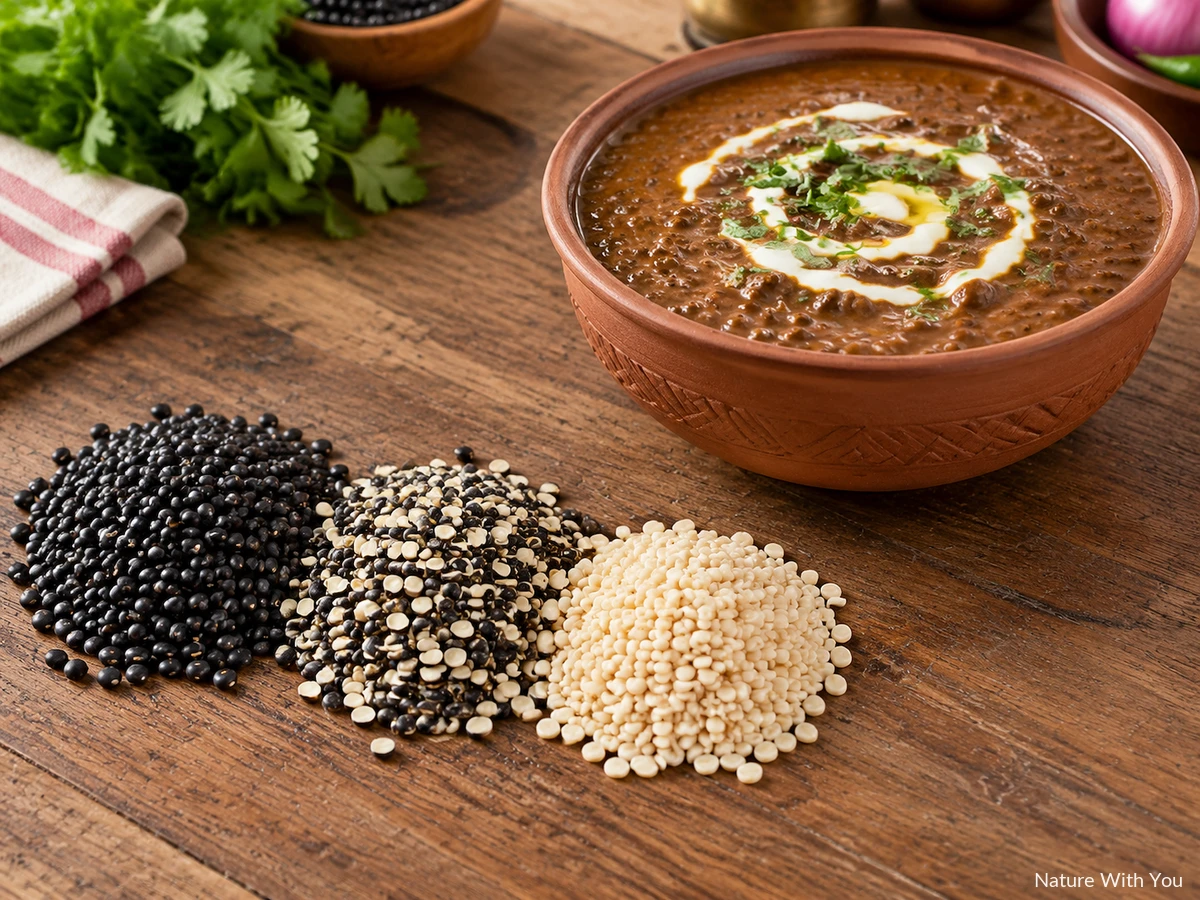
Urad dal is the small black bean (Vigna mungo) that turns up in three very different forms in the Indian kitchen: whole and black in Punjab’s slow-simmered maa di dal and dal makhani, split with the skin on (chilka urad) in everyday dal, and skinned and white (dhuli urad) in idli, dosa, medu vada and papad. In English it is black gram; the classical texts call it Masha.
It is one of the richest pulses in protein and minerals, and also one of the heaviest. Ayurveda treats that heaviness as the point: urad is a building, strengthening food, eaten when digestion is strong enough to use it.
✨ Why It’s Special / Importance
- 💪 Around 25 g of protein per 100g of raw seed, among the highest of the common Indian pulses
- 🌾 Very high in fiber, and a good plant source of iron and magnesium
- 🥣 The only common dal that ferments into a light, airy batter, which makes idli and dosa possible
- ❄️ A traditional winter food, prized for warmth and nourishment in the cold months
- 🍛 Carries some of the richest dishes of North India, from dal makhani to urad-dal pinni
🏺 Traditional / Ayurvedic Uses
Rasa (Taste): Madhura (Sweet) Virya (Potency): Ushna (Hot) Vipaka (Post-digestive): Madhura (Sweet) Guna (Qualities): Guru (heavy), Snigdha (unctuous) Dosha Effect: Strongly pacifies Vata; increases Kapha and Pitta
Classical Applications:
- Charaka Samhita describes Masha as balya (strength-giving) and vrishya (nourishing to the reproductive tissue), and as one of the foremost Vata-pacifying foods
- It is guru — heavy to digest — and adds bulk to the stool, so the texts pair it with a strong agni
- Its hot potency puts it firmly on the heating side of the hot and cold foods list
- Traditionally cooked with hing, ginger and cumin, which help the body handle its weight
- Favoured in Hemanta and Shishira (early and late winter), when digestive fire runs highest
In Ayurveda’s own reckoning this is ahara (food), not aushadha.
💪 Benefits / Health Effects
- ✅ Strength and Stamina: Dense protein and calories make it a filling, sustaining food for physically active people
- ✅ Vata Balance: Its warm, unctuous nature may help steady the dryness and restlessness associated with Vata
- ✅ Digestive Regularity: The high fiber content supports bowel regularity when the dal is well cooked
- ✅ Minerals: Contributes iron, magnesium and potassium to a vegetarian plate
- ✅ Complete Meals: Paired with rice (idli, dosa) or wheat (dal with roti), it rounds out the protein of the grain
🥗 Nutritional Information (Per 100g, Raw)
Figures are USDA FoodData Central values for mungo beans, mature seeds, raw (whole urad). Split and skinned dal will differ slightly, mostly in fiber.
| Nutrient | Amount |
|---|---|
| Calories | 341 kcal |
| Carbohydrates | 59 g |
| Fiber | 18.3 g |
| Protein | 25.2 g |
| Fat | 1.6 g |
| Iron | 7.6 mg |
| Magnesium | 267 mg |
| Potassium | 983 mg |
Note: Cooking roughly triples the weight of dry dal, so a cooked bowl carries about a third of these figures per 100g.
🔄 Quick Comparison: Urad Dal vs Moong Dal
| Feature | Urad Dal (Masha) | Moong Dal (Mudga) |
|---|---|---|
| Virya | Ushna (hot) | Sheeta (cool) |
| Digestion | Guru — heavy, slow | Laghu — light, quick |
| Dosha Effect | Pacifies Vata; raises Kapha, Pitta | Pacifies Kapha and Pitta |
| Best Season | Winter | Summer, monsoon, and year-round |
| Typical Dishes | Dal makhani, idli, dosa, vada | Khichdi, chilla, sprouts, dal ka pani |
🥄 How to Use / Prepare
Soaking Comes First:
- 💧 Soak whole urad 8 hours or overnight, split urad 3–4 hours; discard the water
- 🔥 Cook until fully soft — half-cooked urad is where most of the heaviness comes from
Culinary Tips:
- 🍲 Dal Makhani / Maa di Dal: Whole urad with a little rajma, simmered for hours and finished with ghee, ginger and a pinch of hing
- 🥞 Idli and Dosa Batter: Skinned urad ground with rice and left to ferment overnight; fermentation makes it noticeably lighter
- 🍩 Medu Vada: Soaked urad ground to a thick, fluffy batter with ginger, curry leaves and black pepper
- 🫓 Papad and Badi: Urad flour rolled into papad or spiced and sun-dried into badi, kept for the year
- 🥣 Chilka Urad Dal: The skin-on split dal, tempered with cumin, garlic and green chilli, for everyday meals
⚠️ Precautions / Warnings
- ❗ Heavy to digest — people with weak digestion, frequent bloating or poor appetite do better with small portions or with moong instead
- ❗ Best eaten at lunch, not as a large late dinner
- ❗ Its heat and weight can aggravate Pitta and Kapha; go lighter in peak summer and in damp, sluggish weather
- ⚠️ Always soak and cook thoroughly, and temper with hing or ginger to reduce gas
🎉 Fun Facts / Trivia
- 🫘 Urad and moong are close cousins — both were once classed in the genus Phaseolus before moving to Vigna
- 🥞 The natural mucilage in urad is what traps air during fermentation and gives idli its spongy texture
- 🌾 The white “dhuli” urad is simply black urad with the skin removed
- 🍪 Punjabi pinni — roasted urad flour, ghee and jaggery — is a classic winter sweet
Frequently Asked Questions (FAQs)
Q: Is urad dal hot or cold in nature? A: Hot. Classical texts give Masha an ushna virya, which is why it is treated as a winter pulse in North Indian homes.
Q: Is urad dal hard to digest? A: It is one of the heaviest pulses. Soaking, slow cooking, and tempering with hing and ginger make a real difference; people with weak digestion may still prefer moong.
Q: Which has more protein, urad or moong? A: Per 100g of raw seed they are close — about 25 g for urad and 24 g for moong. The bigger difference is in how heavy each feels, not in the numbers.
Q: Why is urad used in idli and dosa rather than another dal? A: Its mucilage holds the gas produced during fermentation, giving a light, risen batter. Other dals do not ferment as well.
Related Items
- Moong Dal — the light, cooling counterpart
- Chana — another staple pulse of the North Indian kitchen
- Toor Dal (Arhar) — the lighter, cooling dal of the daily thali
- Hot and Cold Foods in Ayurveda — where urad sits on the heating side
- Winter Fruits and Vegetables — the season urad belongs to
- Hing (Asafoetida) — the classic partner for heavy dals
Explore More: Grains, Pulses & Dairy • Vegetables • Herbs • Seasonal Picks • Holistic Living
📚 Sources
- USDA FoodData Central – Mungo beans, mature seeds, raw (SR Legacy)
- Charaka Samhita, Sutrasthana 27 (Annapanavidhi Adhyaya), Shamidhanya Varga — Masha
- Ashtanga Hridaya (Vagbhata), Sutrasthana 6 (Annasvarupa Vijnaniya) — Shimbi Dhanya
- Bhavaprakasha Nighantu (Bhavamishra), Dhanya Varga — Masha