

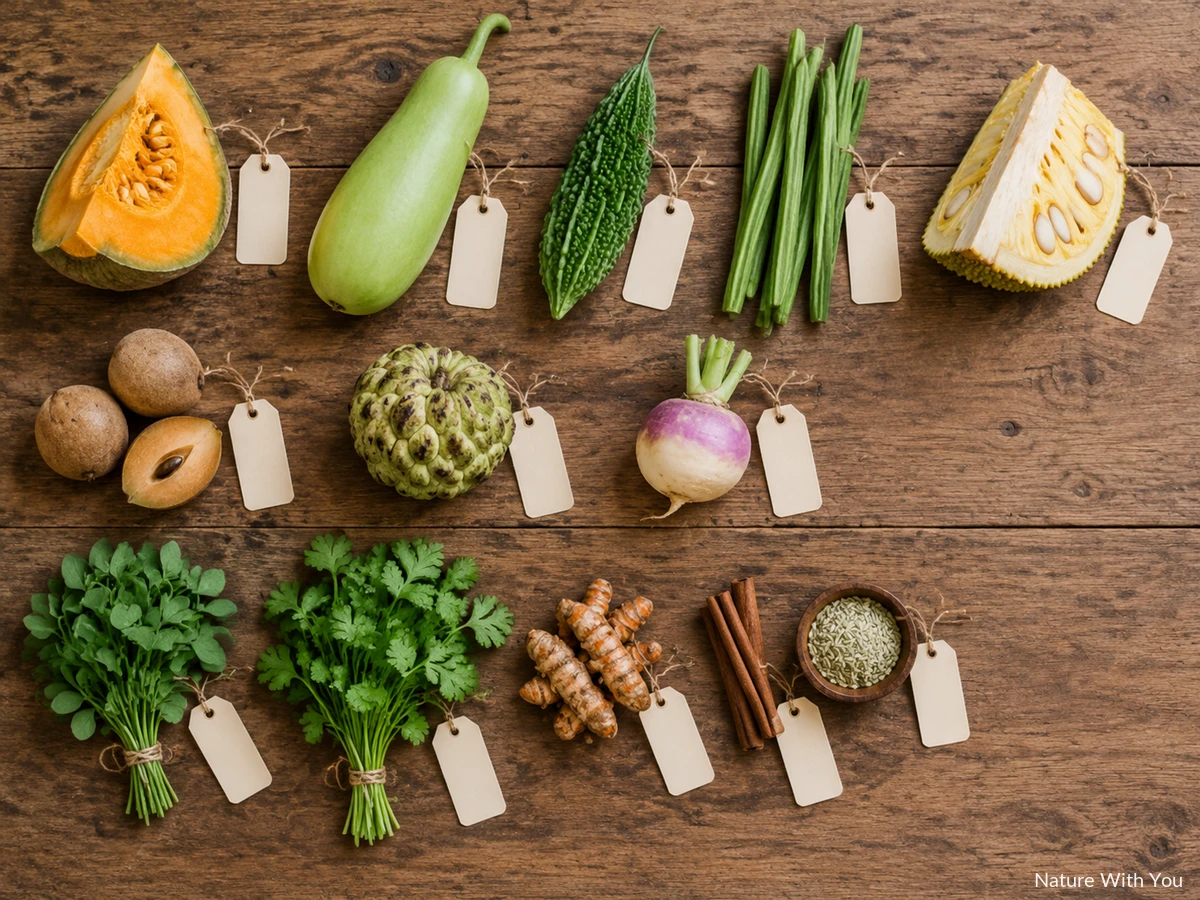
Fruit, Vegetable & Herb Names in Hindi, English & Botanical
Look up any fruit, vegetable or herb by its Hindi, English, regional Indian or botanical name — kaddu, shalgam, chikoo, methi, dhaniya, jeera and more.
Mon, Sep 28, 2026 · 17 min readOne Plant, Many Names
Ask for kaddu in a Delhi market and you will be handed a pumpkin. Ask for the same word in parts of Bihar and eastern Uttar Pradesh and you may well go home with a bottle gourd, the vegetable most of North India calls lauki or ghiya. Say sitaphal in Mumbai and you get a custard apple; say it in some Punjabi and Delhi homes and it means pumpkin again. India has more than twenty major languages and hundreds of local dialects, and its kitchens have named the same plants independently for centuries. Most of the time that richness is a pleasure. When you are reading a recipe, buying a herb, or trying to find a vegetable’s English name, it becomes a puzzle.
Herbs are harder still. Shankhpushpi — “the conch-shaped flower” — is a single name in the classical texts, yet at least four different plants are sold under it in different regions. This site covers three of them on separate pages, Sankhpuspi (Convolvulus pluricaulis), Canscora decussata and Vishnukranta (Evolvulus alsinoides), and a fourth, the blue-flowered Aprajita or butterfly pea, is also called Shankhpushpi in parts of the south and east. The common name tells you the tradition; only the botanical name tells you the plant.
This page collects every fruit, vegetable, herb, grain, pulse and dairy food on Nature With You in one place. Each row gives the English name (linked to the full page), the Hindi name in Devanagari and Roman script, other Indian names where they are well established, and the accepted botanical name.
How to Read a Botanical Name
A botanical name has two parts, written in italics. The first word is the genus, always capitalised; the second is the species epithet, always lower case. In Trigonella foenum-graecum, the botanical name of methi, Trigonella is the genus and foenum-graecum (“Greek hay”) is the species. When the genus has already been mentioned, it is shortened to its first letter — T. foenum-graecum.
A few extra marks turn up in the tables below. spp. means “several species” of that genus. var. marks a cultivated variety, which is how cabbage, cauliflower and broccoli can all be Brassica oleracea and still look nothing alike. A × signals a hybrid, as in the strawberry, Fragaria × ananassa. syn. points to an older name you may still see on packets and in older books. Botanists occasionally revise names as research reclassifies plants; where the accepted name has changed, we give the current one first and the familiar older one after it.
Hindi speakers sometimes search for the vaigyanik naam (वैज्ञानिक नाम) — that is simply the botanical or scientific name.
In the tables, regional names are abbreviated: Ta Tamil, Te Telugu, Ml Malayalam, Kn Kannada, Bn Bengali, Mr Marathi, Pa Punjabi, Gu Gujarati, Ur Urdu, Skt Sanskrit. We have listed only names in wide, settled use; a blank does not mean a language has no word, only that no single word dominates.
Fruits
Many of India’s fruits carry names that are older than the English ones, and several imported fruits have never picked up a Hindi name at all — blueberries, raspberries and kiwis are simply called by their English names in every Indian language. Jackfruit (kathal) and chikoo are two of the most searched: kathal is the same word in Hindi and Urdu, and chikoo is the everyday name for the fruit sold in English as sapota or sapodilla. Shahtoot is the mulberry, a word Hindi and Urdu share with Persian.
| English | Hindi | Other Indian names | Botanical name |
|---|---|---|---|
| Apple | सेब (seb) | Ur: seb | Malus domestica |
| Apricot | खुबानी (khubani) | Ur: khubani, zardalu | Prunus armeniaca |
| Avocado | एवोकाडो (avocado), मक्खनफल (makhanphal) | “butter fruit” in South India | Persea americana |
| Banana | केला (kela) | Skt: kadali; Ta: vazhaipazham; Te: arati pandu; Ml: pazham; Bn: kola; Mr: keli | Musa spp. |
| Blueberry | ब्लूबेरी (blueberry) | — | Vaccinium corymbosum and related species |
| Cherry | चेरी (cherry) | Ur and Kashmir: gilas | Prunus avium (sweet), P. cerasus (sour) |
| Coconut | नारियल (nariyal) | Skt: narikela; Ta: thengai; Te: kobbari; Ml: thenga; Kn: tengu; Bn: narkel | Cocos nucifera |
| Custard Apple | सीताफल (sitaphal), शरीफा (sharifa) | Ta: seetha pazham; Te: seethaphalam; Bn: ata; Mr: sitaphal | Annona squamosa |
| Dragon Fruit | ड्रैगन फ्रूट (dragon fruit) | kamalam (the name adopted in Gujarat) | Selenicereus undatus (syn. Hylocereus undatus) |
| Grapes | अंगूर (angoor) | Skt: draksha; Te and Mr: draksha; Ta: thiraatchai; Bn: angur; dried: kishmish, munakka | Vitis vinifera |
| Guava | अमरूद (amrood) | Ta: koyya; Te: jama; Ml: pera; Bn: peyara; Mr: peru | Psidium guajava |
| Honeydew Melon | हनीड्यू खरबूजा (honeydew kharbuja) | — | Cucumis melo (Inodorus group) |
| Jackfruit | कटहल (kathal) | Ur: kathal; Ta: palapazham; Te: panasa; Ml: chakka; Kn: halasu; Bn: kanthal; Mr: phanas | Artocarpus heterophyllus |
| Jamun | जामुन (jamun) | Ta: naaval pazham; Te: neredu; Ml: njaval; Kn: nerale; Bn: kalo jam; Mr: jambhul | Syzygium cumini |
| Kiwi | कीवी (kiwi) | — | Actinidia deliciosa |
| Lemon | नींबू (nimbu) | Ta: elumichai; Te: nimmakaya; Bn: lebu; Mr: limbu | Citrus limon |
| Mango | आम (aam) | Skt: amra; Ta: maampazham; Te: mamidi; Ml: maanga; Kn: maavu; Mr: amba | Mangifera indica |
| Muskmelon | खरबूजा (kharbuja) | Mr: kharbuj | Cucumis melo |
| Mulberry | शहतूत (shahtoot), तूत (tut) | Ur: shahtoot | Morus alba, M. nigra |
| Orange | संतरा (santra), नारंगी (narangi) | “malta” for the sweet orange in North India; Bn: kamala lebu | Citrus sinensis (sweet orange); santra is usually a mandarin, C. reticulata |
| Papaya | पपीता (papita) | Ta: pappali; Te: boppayi; Ml: kappalanga; Bn: pepe; Mr: papai | Carica papaya |
| Pear | नाशपाती (nashpati) | Ur and Bn: nashpati | Pyrus communis |
| Pineapple | अनानास (ananas) | Bn: anaras; Mr: ananas | Ananas comosus |
| Pomegranate | अनार (anar) | Skt: dadima; Ta: maadhulai; Te: daanimma; Bn: dalim, bedana; Mr: dalimb | Punica granatum |
| Raspberry | रास्पबेरी (raspberry) | — | Rubus idaeus |
| Sapota | चीकू (chikoo) | sapodilla; Ta and Kn: sapota; Bn: sofeda; Mr: chikku | Manilkara zapota |
| Strawberry | स्ट्रॉबेरी (strawberry) | — | Fragaria × ananassa |
| Watermelon | तरबूज़ (tarbooz) | Ta: tharpoosani; Te: puchakaya; Bn: tormuj; Mr: kalingad | Citrullus lanatus |
Vegetables
Vegetables are where regional usage shifts the most, because they are bought daily from local sellers rather than packaged under a standard label. Three members of the gourd family account for much of the confusion: pumpkin (kaddu), bottle gourd (lauki) and ash gourd (petha). The cabbage family is the opposite case — one species, Brassica oleracea, gives cabbage, cauliflower and broccoli, while turnip (shalgam) belongs to a close relative, Brassica rapa. Drumstick, the long pod Hindi calls sahjan and Tamil murungakkai, comes from the same tree as moringa leaves, so both rows carry the same botanical name.
| English | Hindi | Other Indian names | Botanical name |
|---|---|---|---|
| Asparagus | एस्पैरागस (asparagus) | — (not the same as shatavari) | Asparagus officinalis |
| Beetroot | चुकंदर (chukandar) | — | Beta vulgaris |
| Bell Pepper | शिमला मिर्च (shimla mirch) | capsicum | Capsicum annuum |
| Bitter Gourd | करेला (karela) | Ta: paavakkai; Te: kakarakaya; Ml: paavakka; Bn: korola, uchhe; Mr: karle | Momordica charantia |
| Bottle Gourd | लौकी (lauki), घिया (ghiya) | Skt: alabu; Mr: dudhi; Ta: suraikkai; Te: sorakaya; Bn: lau | Lagenaria siceraria |
| Broccoli | ब्रोकली (broccoli) | — | Brassica oleracea var. italica |
| Cabbage | पत्ता गोभी (patta gobhi), बंद गोभी (band gobhi) | Ta: muttaikose; Bn: bandhakopi; Mr: kobi | Brassica oleracea var. capitata |
| Carrot | गाजर (gajar) | Bn: gajor; Mr: gajar | Daucus carota subsp. sativus |
| Cauliflower | फूलगोभी (phool gobhi) | Bn: phulkopi; Mr: phulkobi | Brassica oleracea var. botrytis |
| Cucumber | खीरा (kheera) | Ta: vellarikkai; Te: dosakaya; Bn: shosha; Mr: kakdi | Cucumis sativus |
| Drumstick | सहजन (sahjan), सहजन की फली (sahjan ki phali) | munga; Ta: murungakkai; Te: munagakaya; Ml: muringakka; Kn: nuggekai; Bn: sajne data; Mr: shevga | Moringa oleifera |
| Moringa Leaves | सहजन के पत्ते (sahjan ke patte) | Ta: murungai keerai; Ml: muringa ila | Moringa oleifera |
| Eggplant | बैंगन (baingan) | brinjal; Ta: kathirikkai; Te: vankaya; Ml: vazhuthananga; Kn: badanekai; Bn: begun; Mr: vangi | Solanum melongena |
| Fenugreek | मेथी (methi) | Pa: methi (ਮੇਥੀ); Ta: vendhayam; Te: menthulu; Ml: uluva; Kn: menthya; Bn and Mr: methi; dried leaves: kasuri methi | Trigonella foenum-graecum |
| Garlic | लहसुन (lahsun) | Skt: lashuna; Ta: poondu; Te: vellulli; Ml: veluthulli; Kn: bellulli; Bn: rosun; Mr: lasun | Allium sativum |
| Green Beans | फ्रेंच बीन्स (French beans), फली (phali) | Mr: pharasbi | Phaseolus vulgaris |
| Lettuce | सलाद पत्ता (salad patta) | — | Lactuca sativa |
| Okra | भिंडी (bhindi) | ladyfinger; Ta: vendakkai; Te: bendakaya; Ml: vendakka; Kn: bende; Bn: dherosh; Mr: bhendi | Abelmoschus esculentus |
| Onion | प्याज़ (pyaz) | Ta: vengayam; Te: ullipaya; Ml: savala; Kn: eerulli; Bn: peyaj; Mr: kanda | Allium cepa |
| Peas | मटर (matar) | Ta: pattani; Bn: motorshuti | Pisum sativum |
| Potato | आलू (aloo) | Ta: urulaikizhangu; Te: bangaladumpa; Bn: alu; Mr: batata | Solanum tuberosum |
| Pumpkin | कद्दू (kaddu), काशीफल (kashiphal) | sitaphal in parts of North India; Ta: parangikkai; Te: gummadikaya; Ml: mathanga; Bn: kumro; Mr: lal bhopla | Cucurbita moschata, C. maxima |
| Radish | मूली (mooli) | Ta and Te: mullangi; Bn and Mr: mula | Raphanus sativus |
| Spinach | पालक (palak) | Bn: palong shak | Spinacia oleracea |
| Sweet Potato | शकरकंद (shakarkand) | Ta: sakkaravalli kizhangu; Te: chilagada dumpa; Bn: ranga alu; Mr: ratale | Ipomoea batatas |
| Tomato | टमाटर (tamatar) | Ta: thakkali; Bn: tomato | Solanum lycopersicum |
| Turnip | शलगम (shalgam) | Pa: shalgam; Ur: shaljam; Kashmiri: gogji | Brassica rapa subsp. rapa |
Herbs & Spices
The spice box is where English names help least. Dalchini is cinnamon, laung is clove, jaiphal is nutmeg and hing is asafoetida, but many herbs used in Ayurveda have no everyday English name at all and are known internationally by their Sanskrit or Hindi one — ashwagandha, brahmi, giloy, shatavari, tulsi. For these the botanical name is the only reliable bridge between languages. Two searches come up again and again: seeragam is the Tamil word for cumin (jeera), and kumkuma puvvu is the Telugu name for saffron (kesar).
| English | Hindi | Other Indian names | Botanical name |
|---|---|---|---|
| Ajwain (Carom) | अजवाइन (ajwain) | Ta: omam; Te: vaamu; Ml: ayamodakam; Kn: oma; Bn: jowan; Mr: ova | Trachyspermum ammi |
| Aloe Vera | ग्वारपाठा (gwarpatha), घृतकुमारी (ghritkumari) | Te: kalabanda; Mr: korphad | Aloe vera (syn. A. barbadensis) |
| Amla (Indian Gooseberry) | आंवला (amla) | Skt: amalaki; Ta: nellikkai; Te: usirikaya; Ml: nellikka; Kn: nellikai; Bn: amloki; Mr: avla | Phyllanthus emblica (syn. Emblica officinalis) |
| Aprajita (Butterfly Pea) | अपराजिता (aprajita) | Ta: sangu poo; Ml: shankhupushpam; Bn: aparajita; Mr: gokarna | Clitoria ternatea |
| Ashwagandha | अश्वगंधा (ashwagandha) | Ta: amukkara; Te: pennerugadda; Ml: amukkuram | Withania somnifera |
| Black Pepper | काली मिर्च (kali mirch) | Skt: maricha; Ta: milagu; Te: miriyalu; Ml: kurumulaku; Kn: menasu; Bn: golmorich; Mr: kali miri | Piper nigrum |
| Brahmi | ब्राह्मी (brahmi) | Ta: neer brahmi; Bn: brahmi shak | Bacopa monnieri |
| Canscora decussata | शंखाहुली (shankhahuli) | sold as shankhpushpi in Kerala | Canscora decussata |
| Cardamom | इलायची (elaichi), छोटी इलायची (chhoti elaichi) | Ta: elakkai; Ml: elakkaya; Kn: elakki; Bn: elach; Mr: velchi | Elettaria cardamomum; black cardamom (badi elaichi) is Amomum subulatum |
| Chamomile | बबूने का फूल (babune ka phool) | Ur: babuna | Matricaria chamomilla |
| Cinnamon | दालचीनी (dalchini) | Skt: twak; Ta: lavangapattai; Te: dalchina chekka; Ml: karuvapatta; Kn: chakke; Bn: daruchini | Cinnamomum verum; cassia is C. cassia |
| Clove | लौंग (laung) | Ta: kirambu; Te: lavangalu; Ml: grambu; Bn: labanga; Mr: lavang | Syzygium aromaticum |
| Coriander | धनिया (dhaniya) | Ta: kothamalli; Te: kothimeera (leaf), dhaniyalu (seed); Ml: malli; Kn: kottambari; Bn: dhone; Mr: kothimbir (leaf), dhane (seed) | Coriandrum sativum |
| Cumin | जीरा (jeera) | Ta: seeragam; Te: jeelakarra; Ml: jeerakam; Kn: jeerige; Bn: jira; Mr: jire | Cuminum cyminum |
| Fennel | सौंफ (saunf) | Ta: perunjeeragam; Te: sopu; Ml: perumjeerakam; Kn: sompu; Bn: mouri; Mr: badishep | Foeniculum vulgare |
| Giloy | गिलोय (giloy) | Skt: guduchi, amrita; Ta: seenthil; Te: tippa teega; Ml: chittamruthu; Kn: amruthaballi; Bn: gulancha; Mr: gulvel | Tinospora cordifolia |
| Ginger | अदरक (adrak); dried: सोंठ (saunth) | Ta: inji; Te: allam; Ml: inchi; Kn: shunti; Bn: ada; Mr: ale | Zingiber officinale |
| Gotu Kola | मंडूकपर्णी (mandukaparni) | Ta: vallarai; Te: saraswati aku; Ml: kudangal; Bn: thankuni | Centella asiatica |
| Hing (Asafoetida) | हींग (hing) | Ta: perungayam; Te: inguva; Ml: kaayam; Kn: ingu | Ferula assa-foetida |
| Mint | पुदीना (pudina) | Ta: pudhina | Mentha spicata (spearmint), M. × piperita (peppermint) |
| Mulethi (Licorice) | मुलेठी (mulethi) | Skt: yashtimadhu; Ta: athimathuram; Te: athimadhuram | Glycyrrhiza glabra |
| Mustard Seed | राई (rai), सरसों (sarson) | Ta: kadugu; Te: aavalu; Ml: kaduku; Kn: saasive; Bn: sorshe; Mr: mohari | Brassica juncea (rai), B. rapa (yellow sarson), B. nigra (black mustard) |
| Neem | नीम (neem) | Ta: vembu; Te: vepa; Ml: aryaveppu; Kn: bevu; Mr: kadunimb | Azadirachta indica |
| Nutmeg | जायफल (jaiphal); mace: जावित्री (javitri) | Ta: jathikkai; Te: jajikaya; Ml: jathikka | Myristica fragrans |
| Rose | गुलाब (gulab) | Skt: shatapatri | Rosa damascena, R. centifolia |
| Saffron | केसर (kesar) | Ur: zafran; Kashmiri: kong; Te: kumkuma puvvu; Ta: kungumapoo; Ml: kunkumapoovu | Crocus sativus |
| Sankhpuspi | शंखपुष्पी (shankhpushpi) | — | Convolvulus pluricaulis (listed by Kew as C. prostratus) |
| Shatavari | शतावरी (shatavari) | Ta: thaneervittan kizhangu | Asparagus racemosus |
| Tulsi (Holy Basil) | तुलसी (tulsi) | Ta: thulasi; Te: tulasi; Ml: thulasi | Ocimum tenuiflorum (syn. O. sanctum) |
| Turmeric | हल्दी (haldi) | Ta: manjal; Te: pasupu; Ml: manjal; Kn: arishina; Bn: holud; Mr: halad | Curcuma longa |
| Vishnukranta | विष्णुकांता (vishnukanta) | Skt: vishnukranta; Ml: vishnukranthi | Evolvulus alsinoides |
Grains, Pulses & Dairy
Grains and dals are bought loose by the kilo, so they keep their local names more stubbornly than anything else in the kitchen. The same yellow dal is arhar in Lucknow, tuvar in Ahmedabad and thuvaram paruppu in Chennai; the same millet is ragi in Bengaluru, nachni in Pune and mandua in the Kumaon hills. The dal names also shift with the form: sabut means whole, chilka split with the skin on, and dhuli split and skinned, so dhuli moong and sabut moong are one plant sold two ways. The classical texts had names of their own for most of these, and several survive in everyday words: godhuma became gehun, yava became jau.
| English | Hindi | Other Indian names | Botanical name |
|---|---|---|---|
| Bajra (Pearl Millet) | बाजरा (bajra) | Ta: kambu; Te: sajjalu; Kn: sajje; Mr and Gu: bajri | Cenchrus americanus (syn. Pennisetum glaucum) |
| Barley | जौ (jau) | Skt: yava; Te: yavalu; Bn: job; Mr: jav | Hordeum vulgare |
| Chickpea (Chana) | चना (chana); white: काबुली चना (kabuli chana) | Bengal gram; Skt: chanaka; Ta: kadalai; Te: senagalu; Ml: kadala; Kn: kadale; Bn: chhola; Mr: harbhara; flour: besan | Cicer arietinum |
| Jowar (Sorghum) | ज्वार (jowar) | Skt: yavanala; Ta: cholam; Te: jonnalu; Kn: jola; Mr: jwari; Gu: juvar | Sorghum bicolor |
| Masoor Dal (Red Lentil) | मसूर (masoor) | Skt: masura; Ta: mysore paruppu; Bn: musur; Mr: masoor | Lens culinaris |
| Moong Dal (Green Gram) | मूँग (moong) | mung bean; Skt: mudga; Ta: paasi paruppu; Te: pesalu, pesara pappu; Ml: cherupayar; Kn: hesaru; Bn and Mr: mug | Vigna radiata |
| Ragi (Finger Millet) | रागी (ragi), मंडुआ (mandua) | Ta: kezhvaragu; Te: ragulu; Kn: ragi; Mr: nachni; Bn: marua | Eleusine coracana |
| Rice | चावल (chawal); paddy: धान (dhaan) | Skt: shali, tandula; Ta: arisi; Te: biyyam; Ml: ari; Kn: akki; Bn: chal; Mr: tandul | Oryza sativa |
| Toor Dal (Pigeon Pea) | अरहर (arhar), तूर (toor) | Skt: adhaki; Ta: thuvaram paruppu; Te: kandi pappu; Ml: thuvara parippu; Kn: togari bele; Mr: tur; Gu: tuvar | Cajanus cajan |
| Urad Dal (Black Gram) | उड़द (urad) | Skt: masha; Ta: ulundhu; Te: minumulu, minapa pappu; Ml: uzhunnu; Kn: uddu; Bn: kalai; Pa: maah | Vigna mungo |
| Wheat | गेहूँ (gehun) | Skt: godhuma; Ta: godhumai; Te: godhumalu; Ml: gothambu; Kn: godhi; Bn: gom; Mr: gahu | Triticum aestivum |
Dairy foods have no botanical name, so the last column below gives the classical Sanskrit name instead. Ayurveda named milk and fresh butter in detail; paneer and khoa are later kitchen preparations with no entry of their own in the classical lists.
| English | Hindi | Other Indian names | Classical name |
|---|---|---|---|
| Milk | दूध (doodh) | Ta and Ml: paal; Te: paalu; Kn: haalu; Bn and Pa: dudh | ksheera, dugdha |
| White Butter | मक्खन (makkhan) | Ta: vennai; Te and Ml: venna; Kn: benne; Bn: makhon; Mr: loni | navaneeta |
| Paneer | पनीर (paneer) | Bn: chhana; Odia: chhena (the softer, unpressed form) | — |
| Khoa (Mawa) | खोया (khoya), मावा (mawa) | Mr and Gu: mava; Ta and Te: kova | — |
Commonly Confused Names
Kaddu, lauki and petha
Across most of North India kaddu is the orange-fleshed pumpkin, also sold as kashiphal or kumhda. In Bihar and eastern Uttar Pradesh, though, kaddu often means the pale green bottle gourd, which Delhi and Punjab call lauki or ghiya. A third gourd, the waxy white ash gourd that becomes Agra’s petha sweet, is the one classical Ayurvedic texts call Kushmanda (Benincasa hispida). Pumpkin arrived in India from the Americas and has borrowed the name since. Do not confuse any of these with kadu, the Marathi word for “bitter”, which turns up in kadunimb (neem).
Sitaphal the fruit and sitaphal the pumpkin
In Maharashtra, Gujarat and the south, sitaphal is the custard apple, the knobbly green fruit with sweet white segments. In some Punjabi and Delhi households sitaphal is pumpkin. Its relatives muddy things further: ramphal is Annona reticulata, a smoother, reddish cousin, and lakshman phal is usually the soursop, Annona muricata. All three are different species.
Sarson and rai
Both are mustard, but not the same one. Rai is the small dark brown seed that crackles in a South Indian tadka and goes into North Indian pickle; it is mostly Brassica juncea. Sarson usually means the yellow-flowered crop of Punjab and Rajasthan pressed for mustard oil, and the greens in sarson ka saag, mostly Brassica rapa varieties along with B. juncea. True black mustard, B. nigra, is less common in Indian fields today.
Jeera, shahi jeera, kalonji and saunf
Jeera is ordinary cumin. Shahi jeera or kala jeera is a thinner, darker, sweeter seed, Bunium persicum, grown in Kashmir and Himachal. Kalonji is nigella (Nigella sativa), sometimes wrongly sold as “black cumin” or “onion seed”. Saunf is fennel, and Tamil perunjeeragam literally means “big cumin” though it is not cumin at all. Vilayati saunf can mean anise, Pimpinella anisum.
Kathal, breadfruit and chikoo
Kathal is jackfruit, and English has no other name for it. Breadfruit, Artocarpus altilis, is a close relative grown in coastal Kerala and Karnataka, smaller and without the jackfruit’s many seeds and pods. Chikoo is sapota or sapodilla, an entirely different fruit from a tree whose latex once supplied chewing gum.
Shahtoot and rasbhari
Shahtoot (or tut) is the mulberry. Rasbhari, which sounds as though it should mean raspberry, is the cape gooseberry, Physalis peruviana, a small golden fruit in a papery husk. Neither is related to raspberry.
Santra, narangi and malta
The loose-skinned santra of Nagpur and narangi are mandarins, Citrus reticulata. The tighter-skinned sweet orange, C. sinensis, is often sold as malta in North India, and mosambi is the sweet lime, C. limetta.
Ragi, mandua and kodo
Ragi, mandua and nachni are one grain, finger millet. In Nepal and parts of the Himalaya it is also called kodo, but in the rest of India kodo means a different millet altogether, kodo millet, Paspalum scrobiculatum, a small pale grain cooked like rice. Check the colour: finger millet is reddish-brown and powdery when ground; kodo is straw-coloured.
Khoa, mawa, chhena and paneer
Khoa, khoya and mawa are the same thing: milk simmered and stirred until almost all its water has gone. Chhena and paneer are made the other way, by splitting hot milk with something sour. Chhena is the soft, kneadable curd that Bengali and Odia sweets such as rasgulla start from; pressed firm under a weight, the same curd becomes paneer.
FAQs
What is kaddu called in English?
Kaddu is pumpkin. In parts of Bihar and eastern Uttar Pradesh the same word can mean bottle gourd, so if the vegetable is long and pale green rather than round and orange, it is lauki.
What is shalgam in English?
Shalgam (also shaljam in Urdu) is turnip, Brassica rapa subsp. rapa.
What is the botanical name of methi?
Methi, or fenugreek, is Trigonella foenum-graecum. The same plant gives both the leaves and the seeds. In Punjabi it is also methi.
What is dhaniya ka vaigyanik naam?
The scientific name of dhaniya (coriander) is Coriandrum sativum. The leaves and the dried seeds come from the same plant.
What are lehsun and dalchini in English?
Lehsun is garlic (Allium sativum) and dalchini is cinnamon (Cinnamomum verum, though much dalchini sold in India is cassia).
What is sahjan in English?
Sahjan is the drumstick tree, Moringa oleifera. Its pods are drumsticks and its leaves are moringa leaves.
What is giloy called in Malayalam?
Giloy is chittamruthu in Malayalam and guduchi or amrita in Sanskrit.
What are jowar, bajra and ragi called in English?
Jowar is sorghum, bajra is pearl millet and ragi is finger millet. All three are gluten-free millets, and in Hindi-speaking hill areas ragi is also known as mandua.
What are arhar, urad and masoor dal in English?
Arhar or toor dal is pigeon pea, urad dal is black gram and masoor dal is red lentil. Moong dal, the fourth everyday dal, is green gram or mung bean.
Sources
- The Wealth of India: Raw Materials series, CSIR–National Institute of Science Communication and Information Resources (NISCAIR), New Delhi
- Plants of the World Online, Royal Botanic Gardens, Kew — accepted names and synonyms
- Bhavaprakasha Nighantu of Bhavamishra — classical Sanskrit names of foods and medicinal plants
- The Ayurvedic Pharmacopoeia of India, Part I, Ministry of AYUSH, Government of India — official and regional names of pharmacopoeial herbs