

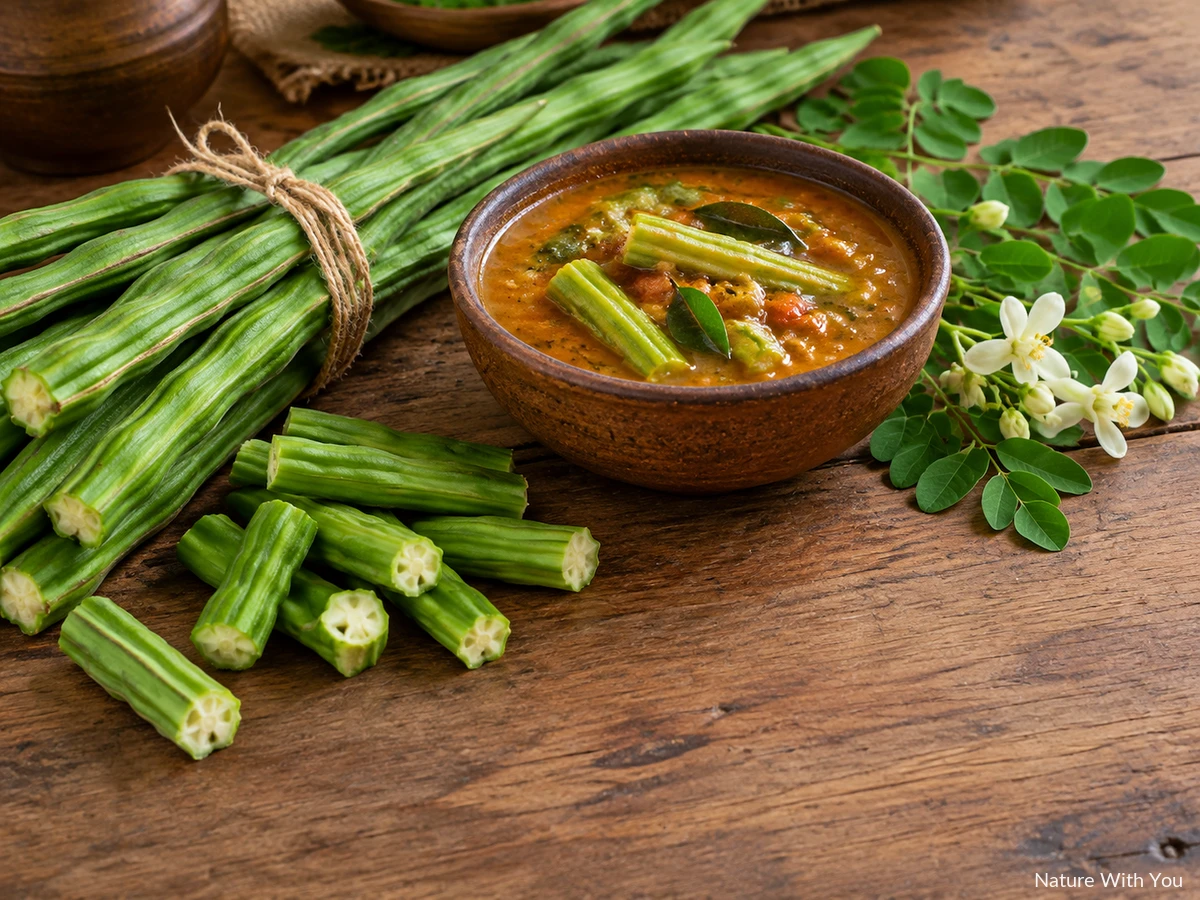
Drumstick (Sahjan) – Moringa Pods, Leaves & Benefits
Drumstick (Sahjan) pods, flowers and leaves: the Ayurvedic view of Shigru, nutrition per 100g, sambar and sabzi ideas, and when to go easy on it.
Mon, Sep 28, 2026 · 6 min read🌿 Drumstick at a Glance
Drumstick is the long, ridged green pod of the moringa tree (Moringa oleifera) — Sahjan or Sehjan in North India, Munga in Chhattisgarh and Madhya Pradesh, Murungakkai in Tamil Nadu. One tree feeds the kitchen three ways: the pods go into sambar and curries, the white flowers are cooked in early spring, and the small leaves are cooked as greens. This page is about the tree as a vegetable, with the pods first. Ayurveda knows it as Shigru, a light, pungent, warming food for the heavy, damp end of the year.
✨ Why It’s Special / Importance
- 🫛 The pods are one of the richest vegetable sources of vitamin C in the Indian kitchen, at about 141 mg per 100g raw
- 🥔 A good source of potassium and fiber, with very few calories
- 🌸 The flowers are a seasonal delicacy, available only for a few weeks around Holi
- 🌳 A fast-growing, drought-hardy tree that grows in backyards across India
🏺 Traditional / Ayurvedic Uses
Rasa (Taste): Katu–Tikta (Pungent–Bitter) Virya (Potency): Ushna (Hot) Vipaka (Post-digestive): Katu (Pungent) Dosha Effect: Pacifies Kapha and Vata; increases Pitta, and the Bhavaprakasha notes it can provoke rakta (the blood) as well
Classical Applications:
- The Bhavaprakasha Nighantu describes Shigru as laghu (light), ruksha (dry) and tikshna (sharp), a deepana that kindles the digestive fire and a ruchya that brings back a dull appetite
- Its warmth and dryness make it a classic food for Kapha season — late winter and spring, when the body feels heavy and sluggish
- The root and bark belong to the medicinal tradition, not the kitchen; the pods, flowers and leaves are the parts eaten as shaka (vegetable)
In Ayurveda’s own reckoning, the pods on your plate are ahara (food), not aushadha.
💪 Benefits / Health Effects
- ✅ Vitamin C: A single serving of cooked pods supplies a large share of the day’s need
- ✅ Digestion: Fiber and a light, pungent nature may support regularity and appetite
- ✅ Heaviness and Sluggishness: Traditionally eaten to lift the dull, heavy feeling of damp weather
- ✅ Potassium: Contributes to normal fluid balance and muscle function
- ✅ Antioxidants: Moringa pods and leaves contain polyphenols and have been studied for antioxidant activity
- ✅ Light Nourishment: Filling and flavourful at under 40 kcal per 100g
🥗 Nutritional Information (Per 100g, Raw Pods)
| Nutrient | Amount |
|---|---|
| Calories | 37 kcal |
| Carbohydrates | 8.5 g |
| Fiber | 3.2 g |
| Protein | 2.1 g |
| Fat | 0.2 g |
| Vitamin C | 141 mg |
| Potassium | 461 mg |
| Calcium | 30 mg |
Note: Vitamin C drops with long boiling. Adding the pod pieces to sambar or curry in the last 10–12 minutes, rather than at the start, keeps more of it.
🍃 What About Drumstick Leaves?
Drumstick leaves in English are simply moringa leaves — the same thing as sahjan ke patte in Hindi or murungai keerai in Tamil. Nutritionally they are a different food from the pod: far richer in protein, calcium, iron and vitamin A, and eaten as greens rather than as a vegetable piece. Strip the small leaflets from the stalk, wash well, and add them to dal, a stir-fry or paratha dough towards the end of cooking. For five everyday recipes, see our guide to moringa leaves.
🔄 Quick Comparison: Drumstick vs Green Beans – The Pod Pair
| Feature | Drumstick (Sahjan) | Green Beans (Sem) |
|---|---|---|
| Best For | Sambar, curries, spring meals | Everyday sabzi, stir-fries |
| Key Nutrient | Vitamin C, potassium | Fiber, vitamin K |
| How to Eat | Chew the pulp, discard the skin | Eat the whole pod |
| Ayurvedic Nature | Ushna (heating) | Milder, less heating |
🥄 How to Use / Prepare
Culinary Tips:
- 🍲 Sambar: Cut pods into finger-length pieces and simmer in tamarind-toor dal sambar — the classic South Indian use
- 🥘 Drumstick Curry: Cook with onion, tomato and coconut, or in a Bengali-style mustard gravy with potato
- 🍛 Sahjan ki Sabzi: A dry North Indian sabzi with potato, cumin, turmeric and a little amchur
- 🌸 Flower Bhurji: Blanch the flowers to soften their bitterness, then sauté with onion and green chilli — a spring favourite in Bihar, Uttar Pradesh and Odisha
- 🧆 Flower Pakoras: Dip blanched flowers in spiced besan batter and fry
How to eat the pod: Pick up a piece, split it or press it between your teeth, and scrape out the soft pulp and seeds. The fibrous outer skin is left on the plate.
Traditional Home Remedies:
- 🌿 For a Heavy Spring Appetite: A light dal or soup with drumstick and a pinch of black pepper
- 🧄 For Kapha Days: Pair with ginger and turmeric in a thin, well-spiced sambar
⚠️ Precautions / Warnings
- ❗ Pitta and Summer: Its hot potency can feel too heating in peak summer or for people prone to acidity; balance with coconut, ghee or a cooling side
- ❗ Tough Pods: Old, woody pods are fibrous and hard to chew — choose firm, slender, green pods that bend slightly
- ❗ Pregnancy: Ordinary cooked pods in normal amounts are traditional food, but the root and bark are not food and are traditionally avoided during pregnancy
- ⚠️ Moringa powders and capsules are concentrated products, not the vegetable; this page is about pods, flowers and leaves as eaten at home
🎉 Fun Facts / Trivia
- 🥁 It is called “drumstick” because the long, slender pods look like a drummer’s sticks
- 🌏 The tree is native to the sub-Himalayan foothills of northern India
- 💧 Crushed moringa seeds have been studied as a natural way to clarify cloudy water
- 🛢️ The seed oil, known as ben oil, was once prized by watchmakers and perfumers because it resists going rancid
Frequently Asked Questions (FAQs)
Q: What are drumstick leaves called in English? A: They are called drumstick leaves or moringa leaves. Sahjan ke patte, munga bhaji and murungai keerai all name the same leaves.
Q: How do you eat drumstick leaves? A: Cook them — added to dal, stir-fried with garlic, mixed into paratha dough or blended into chutney. Our moringa leaves guide has step-by-step ideas.
Q: Do you eat the skin of a drumstick? A: No. You eat the soft pulp and tender seeds inside, and leave the fibrous skin.
Q: Can I eat drumstick in summer? A: Yes, in moderate amounts. Ayurveda counts it as heating, so in hot months pair it with coconut, curd rice or other cooling foods, and go easy if you run warm.
Q: Are drumstick pods and moringa leaves the same thing nutritionally? A: No. The pods are watery and rich in vitamin C and potassium; the leaves are far denser in protein, calcium, iron and vitamin A. Both come from the same tree.
Related Items


Explore More: Fruits • Vegetables • Herbs • Natural Remedies • Seasonal Picks • Wellness Tips
📚 Sources
- USDA FoodData Central – Drumstick pods, raw (SR Legacy)
- Bhavaprakasha Nighantu (Bhavamishra), Guduchyadi Varga — Shigru
- Fahey, J. W. (2005). Moringa oleifera: A Review of the Medical Evidence for Its Nutritional, Therapeutic, and Prophylactic Properties. Part 1. Trees for Life Journal, 1:5